
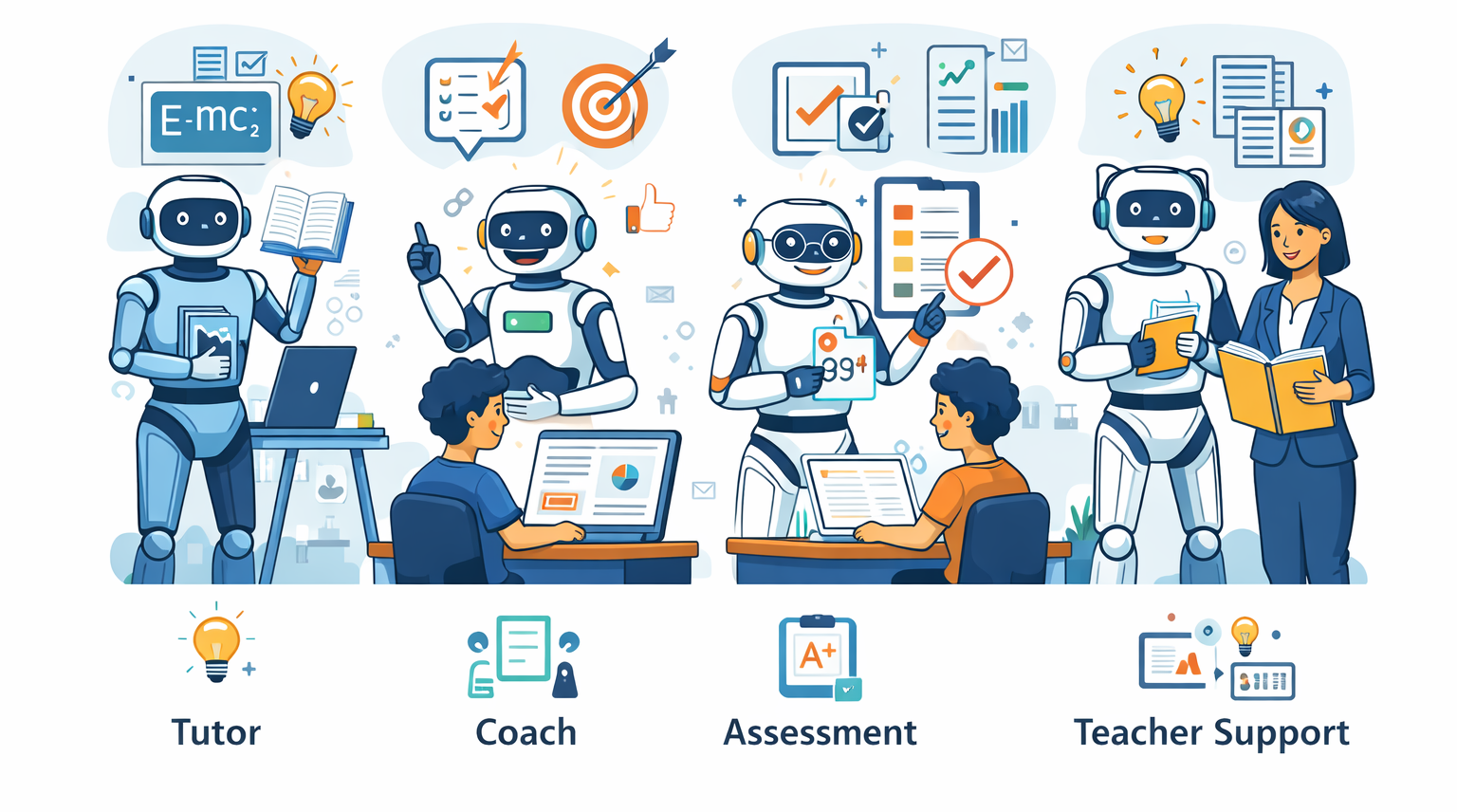
EdTech has scaled faster than education has ever scaled before. Video libraries grew. Dashboards improved. AI chatbots appeared everywhere. Yet learning outcomes barely changed. Completion rates stayed low. Teachers stayed overloaded. Learners stayed passive. The core problem was never access to content. The real problem was the absence of intent, follow through, and adaptation in learning systems.
A 2024 OECD report highlighted that despite $200 billion invested in EdTech globally, student outcomes in core subjects haven’t improved significantly in many regions. The root issue? Many platforms treat learning as a passive process, ignoring the dynamic, goal-oriented nature of human cognition.
Agentic AI represents a paradigm shift from reactive tools to proactive entities capable of long-term interactions. These systems exhibit autonomy, planning, memory, and tool use, satisfying at least four of six criteria (e.g., goal-directed multi-turn interactions and safety guardrails). Unlike traditional AI, which is rule-bound and reactive, agentic AI adapts dynamically, drawing on pedagogical theories like Vygotsky’s Zone of Proximal Development (ZPD) to scaffold learning just beyond a student’s current ability.

A Thoughtful Plan for Implementation
To combat EdTech failures, such as distraction (58% of students report device-related issues per OECD) and inequality (NIH notes widened gaps for low-income learners), this plan focuses on phased implementation of agentic AI based on autonomy levels.
- Strategy 1: Reactive Agents (Low Autonomy)
Reactive agents respond to user inputs without initiative, ideal for entry-level EdTech integration. For example:
Build using LLMs for chat-based interfaces, e.g., a FAQ bot in an app that answers queries like “Explain photosynthesis.” Use rule-based triggers or simple ML for response selection. Deploy as text-based embodiments initially, embedding in mobile apps for accessibility. Train on domain-specific data (e.g., Khan Academy datasets). Rollout: Integrate into existing platforms, test with 100 students, iterate based on usage logs.
- Strategy 2: Adaptive Agents (Moderate Autonomy)
These agents adjust based on short-term feedback, using learner models. For example:
Incorporate ML algorithms (e.g., reinforcement learning) to track performance and adapt content, like increasing difficulty in math apps. Add short-term memory (e.g., session-based vectors) for personalization. Embodiment: Graphical avatars for social presence. Steps: Collect data via A/B testing, fine-tune models with user feedback, integrate multimodal inputs (voice/text). Pilot in K-12 apps, expanding to HE.
- Strategy 3: Proactive Agents (High Autonomy)
Proactive agents initiate actions, using planning modules (e.g., ReAct framework) and persistent memory to set sub-goals. For example:
An agent detects inactivity and suggests personalized exercises. Use multi-tool integration (e.g., API calls to external resources). Embodiment: Embodied in AR/VR for immersion. Process: Develop with frameworks like AutoGen, test for safety (guardrails on actions), deploy in collaborative platforms. Monitor with dashboards for overrides.
- Strategy 4: Collaborative Agents (Highest Autonomy)
These engage in joint planning, using multi-agent systems where AI collaborates with humans/agents (e.g., teacher-AI-student teams). For example:
Implement via APIs for shared decision-making, like co-creating lesson plans. Embodiment: Multimodal for rich interaction. Steps: Use frameworks like MAS-KCL, involve stakeholders in design, ensure interoperability (LTI standards). Scale from small groups to full classrooms.
Agentic AI also introduces real risks. Over automation can weaken learner independence. Poor design can reinforce bias. Excessive scaffolding can reduce critical thinking.
The EdTech companies that win in the next decade will build agents grounded in learning science, not just model capability. They will separate roles across agents instead of creating one do everything bot. They will prioritize trust, transparency, and outcomes over speed and hype. Most importantly, they will treat AI as a force multiplier for teachers and learners, not a replacement.
Source: https://www.linkedin.com/pulse/understanding-agentic-ai-education-manish-kumar-xrjoc